PDF Ebook Electronics: Project Management and Design (2nd Edition) By D. Joseph Stadtmiller
As we specified previously, the technology helps us to constantly identify that life will be constantly much easier. Reviewing e-book Electronics: Project Management And Design (2nd Edition) By D. Joseph Stadtmiller practice is likewise among the benefits to obtain today. Why? Innovation could be utilized to offer guide Electronics: Project Management And Design (2nd Edition) By D. Joseph Stadtmiller in only soft data system that can be opened up every time you really want as well as anywhere you require without bringing this Electronics: Project Management And Design (2nd Edition) By D. Joseph Stadtmiller prints in your hand.
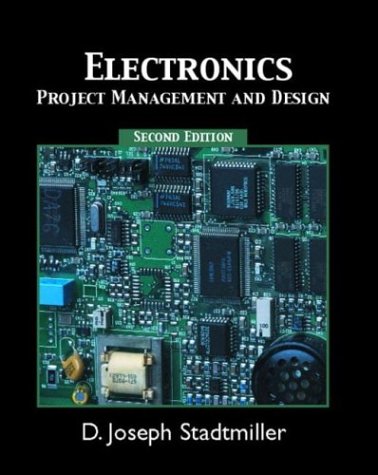
Electronics: Project Management and Design (2nd Edition) By D. Joseph Stadtmiller

PDF Ebook Electronics: Project Management and Design (2nd Edition) By D. Joseph Stadtmiller
Regardless of what to assume, no matter what to do! When you are good reader, you might love all books to review. Yet, many individuals additionally like only to review certain books. And right here, when you end up being the follower of Electronics: Project Management And Design (2nd Edition) By D. Joseph Stadtmiller, this is your time to find over the presence of guide to stand for the perfections. Right here, guide is located with the style of our website. When it is the on-line rest, it will certainly help you to locate the soft data from the books.
As known, we are the best publication site that constantly detail many points of books from different nations. Naturally, you can find and also take pleasure in looking the title by search from the nation and also various other countries on the planet. It means that you can take into consideration many things while locate the intriguing publication to review. Associated with the Electronics: Project Management And Design (2nd Edition) By D. Joseph Stadtmiller that we get rid of currently, we are not question any more. Many individuals have confirmed it; prove that this publication provides great influences for you.
Checking out a publication could assist you to open up the brand-new globe. From knowing nothing to knowing whatever can be gotten to when reading books lot of times. As many people state, extra books you check out, much more points you would like to know, but couple of things you will certainly really feel. Yeah, reading guide will certainly lead your mind to open minded as well as always try to seek for the various other understanding, also from numerous resources. Electronics: Project Management And Design (2nd Edition) By D. Joseph Stadtmiller as a method of just how the book is recommended will certainly be offered for you to get it.
So, all people who review Electronics: Project Management And Design (2nd Edition) By D. Joseph Stadtmiller will certainly seem like doing things on their own. It depends on just how the visitors gaze and consider this book. However, frequently, it really includes the incredible ideas of guide analysis. It will likewise provide you the fantastic systems of imagination. Of course, it will serve you far better concept of excellences. It is why we constantly offer you the very best publication that can make your life much better. Currently, really feel the life to obtain the outstanding methods of publication accomplishment.
- Sales Rank: #1093840 in Books
- Published on: 2003-12-26
- Original language: English
- Number of items: 1
- Dimensions: 9.00" h x .90" w x 7.40" l, 1.45 pounds
- Binding: Paperback
- 432 pages
From the Inside Flap
Preface
Many years ago, I began my engineering career after earning a BSEE degree. Before my senior year, I was fortunate to find summer employment at an electronics company that provided me with important field experience. Even with that experience, there were many job situations that I was not prepared for as I proceeded through the apprentice years of my professional career. So, I gathered and saved the information and skills that I needed to deal with these job situations. As the information accumulated, I got the idea for a book that would discuss practical issues that many electronics professionals encounter on their first job.
Later in my career, I began teaching as an adjunct professor at a local college. My growing file comprised topics of practical information that became natural examples of ways to apply the theoretical subjects I was teaching. Today, my primary career is teaching electronics technology at the college level. Faced with the challenge of preparing students to enter the fast-paced world of electronics, my idea for a book that would help bridge the gap from academia to industry found new life.
During my academic experience, two courses helped bridge this gap for me. The first was a senior project course, where the student selected and defined a design project and then proceeded to complete, build, and test the design. The second was a course on professional methods that dealt with the process of solving engineering problems. These courses formed the foundation for the book.
My first approach was to write a "Senior Project" textbook based upon an engineering problem-solving process. The concept included an actual design project and the many practical topics encountered while completing one. As this concept developed, it naturally expanded and evolved into an electronics project management textbook. This occurred as the initial manuscript presented an example project in a real company setting, which required a discussion of some project management topics. Reviewers' comments suggested the market for an electronics-oriented project management book.
This book prepares electronics professionals for their first job and supplies them with the practical tools that enhance their ability to perform in their first position. To accomplish this, the following strategies were established:
Review the operation of a company Discuss teamwork and the role of the electronics professional Present methods of project management Define an engineering problem-solving process Discuss the practical aspects of an electronic project
This text was developed with my industrial experience as a backdrop and would have been impossible without a transition back into the academic world. My early notes and memories about on-the-job experiences and design problems saw new life as I tried to bring real-world examples into classroom discussions. The material has been class tested with senior project classes for the last two years, and their thoughts, ideas, and comments have provided valuable feedback. Many reviews were completed and these provided many ideas and topics that enhanced the initial manuscript.
The topics discussed in this book are presented in the simplest possible form. The book is intended for use at many levels; but a basic understanding of electronics is assumed. The broad subject area addressed limits the depth to which any concept can be explored. Each chapter starts with an introduction that highlights the topics to be covered. In each section examples are provided wherever practical to enhance the topic discussions. Each chapter concludes with a summary and exercises that will vary depending on the chapter topic. This information is discussed as an actual design project is completed as an ongoing example throughout the book. The project example is included as a separate section at the end of each chapter, starting with Chapter 4.
The book is targeted as a textbook for electronic project management, a senior project, or applied electronics courses. It is most applicable to four-year programs but is also well suited to the second year of a two-year program. The first three chapters axe a preliminary to the actual project discussion. Chapter 1 covers the operation of a typical company, strategic planning, teamwork, and the role of the electronics professional. Chapter 2 discusses engineering project management, concurrent engineering, and total quality management. Chapter 3 addresses the subject of agency approvals.
The Six Steps, a process for solving engineering problems, are presented in Chapter 4. The Six Steps are applied to engineering projects one step at a time in the ensuing chapters. Chapter 5 deals with Step One, Research and Gathering Information. Chapter 6 covers Step Two, Define the Problem and Project Specifications. Step Three, Developing a Solution Plan and Project Scheduling, is presented in Chapter 7. Step Four is the execution of the solution plan or the actual completion of the project. This is discussed in sequence in Chapters 8 through 11 as the topics of preliminary design, component selection, breadboarding, and prototyping are addressed. Chapter 12 discusses Step Five, Design Verification. Chapter 13, the final chapter, reviews Step Six, Conclusion and Project Performance Monitoring. Chapters 4 through 13 cover a complete project.
Included with this text is a copy of the demonstration version of Microsoft Project 98. This is one of the leading project management software packages available. The software is useable for 120 days, enough for one semester. By utilizing Microsoft Project 98, the student will be able to directly apply the discussion presented in Chapter 7 (Project Scheduling) and will be able to complete an actual project schedule.
Three appendixes are supplied as a reference to the project information that is covered in the main body of the book. Appendix A includes reference material for resistors, capacitors, and inductors such as color codes and standard values. Semiconductor package information is included for through-hole and surface-mount technology electronic components. Appendix B is a general reference for test equipment and includes specific measurement methods for digital multimeters and oscilloscopes. Appendix C contains contact information (mail and Web addresses) for professional organizations, periodicals, and approval agencies that are useful to electronics professionals.
An instructor's manual is available with answers/solutions for the end-of-chapter exercises and transparency masters.
I present this book as the "glue" that can hold together all the ether technical and theoretical information that goes into an electronics education. As an instructor in this program, my personal project is to prepare students for jobs in the electronics industry, and this book is a milestone in this important project. Acknowledgments
First, I would like to thank all my teachers, professors, and mentors as they helped me develop the insight that is the basis for this book. Thanks to Donna Conroy, Prentice Hall sales representative, for her suggestion to write this book and her support in obtaining reference material. Many thanks to Scott Sambucci, Acquisitions Editor; Tim Flem, Production Coordinator; and Jim Reidel, Copy Editor, who all worked closely with me to develop and finalize the book.
Special thanks to my design and layout classes of 1998 and 1999 and the reviewers of the manuscript who all had a significant impact on what is now printed on these pages: John Blankenship, DeVry Institute of Technology; Tim Dempsey, DeVry North Brunswick; Julio R. Garcia, San Jose State University; Richard L. Henderson, DeVry Institute of Technology; and Lee Rosenthal, Farleigh Dickinson University.
Finally, thanks to Microsoft Corporation for their support and for allowing the inclusion of Microsoft Project 98 with the book.
Joseph Stadtmiller
Mohawk Valley Community College
From the Back Cover
The primary goal of this text is to better prepare electronics students for their first job, supplying them with the practical tools that will enhance their ability to perform. The text was developed using the author's industry and teaching experience.
Key Features and Benefits:- The text covers a six-step process for solving engineering problems that provides a logical sequence for students to follow while completing electronics projects.
- Design requirements and methods of printed circuit board design and component selection are presented.
- Concurrent engineering and good project management techniques are emphasized throughout the text.
- Electrical noise and ambient temperature effects on electronic circuits are explored in detail.
- All of these topics are discussed as an actual design project is completed as an ongoing example throughout the text.
About the Author
Brian Fagan is one of the leading archaeological writers in the world and an internationally recognized authority on world prehistory. He studied archaeology and anthropology at Pembroke College, Cambridge University, and then spent seven years in sub-Saharan Africa working in museums and in monument conservation and excavating early farming sites in Zambia and East Africa. He was one of the pioneers of multidisciplinary African history in the 1960s. Since 1967, he has been Professor of Anthropology at the University of California, Santa Barbara, where he has specialized in lecturing and writing about archaeology to wide audiences.
Professor Fagan has written six best-selling textbooks: Ancient Lives: An Introduction to Archaeology and Prehistory; In the Beginning; Archaeology: A Brief Introduction; World Prehistory; Ancient Civilizations (with Chris Scarre); and this volume-all published by Prentice Hall-which are used around the world. His general books include The Rape of the Nile, a classic history of Egyptology; The Adventure of Archaeology; TimeDetectives; Ancient North America; The Little Ice Age; and Before California: An Archaeologist Looks at Our Earliest Inhabitants. He was also General Editor of the Oxford Companion to Archaeology. In addition, he has published several scholarly monographs on African archaeology and numerous specialized articles in national and international journals. He is also an expert on multimedia teaching and the recipient of the Society for American Archaeology's first Public Education Award for his indefatigable efforts on behalf of archaeology and education.
Brian Fagan's other interests include bicycling, sailing, kayaking, and good food. He is married and lives in Santa Barbara with his wife and daughter, four cats (who supervise his writing), and last but not least, a minimum of four rabbits.
Electronics: Project Management and Design (2nd Edition)
By D. Joseph Stadtmiller PDF
Electronics: Project Management and Design (2nd Edition)
By D. Joseph Stadtmiller EPub
Electronics: Project Management and Design (2nd Edition)
By D. Joseph Stadtmiller Doc
Electronics: Project Management and Design (2nd Edition)
By D. Joseph Stadtmiller iBooks
Electronics: Project Management and Design (2nd Edition)
By D. Joseph Stadtmiller rtf
Electronics: Project Management and Design (2nd Edition)
By D. Joseph Stadtmiller Mobipocket
Electronics: Project Management and Design (2nd Edition)
By D. Joseph Stadtmiller Kindle