PDF Download How to Reassess Your Chess: Chess Mastery Through Chess Imbalances, by Jeremy Silman
So, when you get this book, it seems that you have found the best selection, not just for today life yet additionally next future. When spending few time to read this book, it will certainly suggest far better compared to investing more times for talking as well as hanging around to lose the moment. This is way, we really recommend How To Reassess Your Chess: Chess Mastery Through Chess Imbalances, By Jeremy Silman a reading publication. It can be your correct buddy being in the cost-free or spare time any place you are. Yeah, you can review it in soft file in your simple tool.
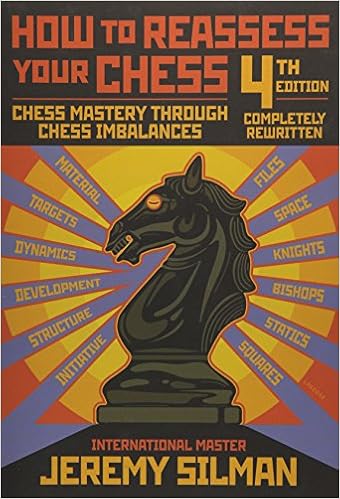
How to Reassess Your Chess: Chess Mastery Through Chess Imbalances, by Jeremy Silman

PDF Download How to Reassess Your Chess: Chess Mastery Through Chess Imbalances, by Jeremy Silman
Checking out the collection on a daily basis may not become your style. You have many tasks as well as tasks to do. However, you should search for some analysis books, from literary to the national politics? Exactly what will you do? Preferring to acquire the book in some cases when you are hanging out with close friends to the book store appropriates. You can search and discover guide as you such as. However, exactly what regarding your referred book is not there? Will you walk around again as well as do look as well as locate anymore? Occasionally, many individuals will be so careless to do it.
And to recommend you a much better publication with excellent quality, you can select How To Reassess Your Chess: Chess Mastery Through Chess Imbalances, By Jeremy Silman Why we refer this publication for you? We understand that you are currently searching for the qualified book related to this topic. Thus, you could start it by getting this book as one of the selected reading publication. It is not concerning the book that is composed by an extremely professional author or released by incredibly popular author. This is about guide that is preferred one and also impact for your demands.
The here and now publication in this title has appeared in greater problem. Some individuals might feel difficult to get it. Yet, with the high innovative technology, you can find the finest from this site. How To Reassess Your Chess: Chess Mastery Through Chess Imbalances, By Jeremy Silman is offered to be downloaded in the soft file. It comes as one of the provided titles of guides develop online collection in the world. When you need various other book collections, just type the title as well as subject or the author. You can discover just what you actually look for or seek.
Become part of those that love to read this publication. If you are the novice visitor, you can use this publication as temptation for you to minimally enjoy reading. Even this book is composed by a specialist author, it does not imply that the words are really tough to understand. You can take some lessons as well as experiences from How To Reassess Your Chess: Chess Mastery Through Chess Imbalances, By Jeremy Silman based upon exactly what you require. This is exactly what calls as advantages of book by analysis. Now, get this book here and also today. It will be offered in the site link to check out.
How to Reassess Your Chess is the popular step-by-step course that will create a marked improvement in anyone's game. In clear, direct language, Silman shows how to dissect a position, recognize its individual parts and ultimately find the move that conforms to the needs of that particular situation. By explaining the thought processes that go into a master's choice of move, the author presents a system of thought that makes advanced strategies seem clear, logical and at times even obvious. How the Reassess Your Chess offers invaluable knowledge and insight that cannot be found in any other book.
Your recently viewed items and featured recommendations
›
View or edit your browsing history
After viewing product detail pages, look here to find an easy way to navigate back to pages you are interested in.
Product details
Paperback: 658 pages
Publisher: Siles Press; 4th edition (October 15, 2010)
Language: English
ISBN-10: 1890085138
ISBN-13: 978-1890085131
Product Dimensions:
6.8 x 1.2 x 9.8 inches
Shipping Weight: 3 pounds (View shipping rates and policies)
Average Customer Review:
4.5 out of 5 stars
137 customer reviews
Amazon Best Sellers Rank:
#40,561 in Books (See Top 100 in Books)
I am about a quarter through this book and I would give it no more than 3.5 stars. Jeremy Silman is a fine writer and always tries to make his prose and instructions fun and peppered with jokes (some work, others don't). As an intermediate level player (probably around B or C category) I got this book in the hope that it would help me obtain some strategic concepts and help me navigate middle-game situations better. The problem with this book, as with many chess instructional books generally, is that strategic ideas in chess by themselves are largely useless, unless accompanied by solid tactics and analysis. For example, after studying a chapter on rooks on the 7th and 8th ranks, I came out with almost no more knowledge or understanding than before. Because while he provides interesting examples of when that concept works and when it doesn't, the only real lesson of those examples is: you need to calculate! Could he have supplied better examples where a visualization of the position would provide a better understanding, rather than detailed analysis? I am not sure. Were there lessons to be drawn from those examples that Silman could have explained more cogently? Also not sure.By contrast, I would give Silman's endgame book a rating of 4.5-5. Maybe it's because endgames lend themselves better to more lucid analysis and technique and therefore easier to understand for an intermediate player. Here's the bottom line: if you are an intermediate level player who is not familiar with many concepts in this book, perhaps it could be instructional. For example, knights generally do better in closed positions (more pawns on the board); bishops better in open positions (fewer pawns on the board); or that one ought to aim to place rooks on the 7th/8th rank. But without concrete analysis, these concepts are largely meaningless. Therefore, as a book of ideas, accompanied by seemingly random examples of application, this book could be useful. But I personally find going over master games, with move by move annotations, which includes both verbal prose and concrete analysis, a more useful use of chess study time.
I'm a strong expert chess player (~2170) and a former chess tutor/teacher. Thus, I have owned, read, and taught from a LOT of chess books. So it's not a small thing for me to say that Reassess Your Chess is the best chess book I've ever read.Silman's discussion of imbalances is clear, well-thought-out, and illustrated with excellent examples. The writing is fluid, conversational, and, occasionally, quite humorous. And, specific to the 4th edition, I appreciate that Silman used entirely new examples. This isn't just changing three words and slapping on a new edition number as a quick money grab -- it's well worth buying the new edition even if you already have the 3rd Edition of Reassess.A minor caution: It's not easy or low-level material, and if you're trying to go, say, from under 1000 to 1200 you're probably better off with The Amateur's Mind or something even more basic. But if you're looking to get up to A or B class, to say nothing of Expert and beyond, you really can't do better than this.
Silman gives excellent instruction and is an enjoyable chess coach.So, five stars. Drop one star because there are way too many sidehighlights to arbitrary advice, like "do this, don't do that." Tenpages later there is another set of highlights. It makes this allsound easy and simple when, in fact, he is giving detailed analysis.(Example: On page 228, "Rule --- Trade minor pieces when youropponent has an isolated pawn." Then, on page 236, "Rule ---Trade minor pieces when your opponent has a backward pawn."However, a major section and theme of the book repeats overand over the opposite advice --- "Don't trade your useful andactive pieces for the opponent's badly placed inactive pieces.")Drop another star because there are 280 (!) annotated midgamepositions, most all are shown after twenty starting moves (no notes),without any opening index! So, Reassess is, in fact, a midgame puzzlebook. There is never any connection made to the openings, closed, open,semi-closed, or semi-open.(Note -- I didn't knock off a star for this next one ---) The test answer diagramsare too small except in bright light. The printing is fine, but a white bishop on adark square is near invisible. I flipped back 400 pages to check the question diagram.A lot of the instruction happens in the answer section (200+ pg.) so I got reallyfrustrated without having a bright light. Even in bright light the answer diagramis too hard to focus, it's an 8x8 chess board that's 1.1 inch on a side. True, when thetest answer is long, Silman does show a bigger updated diagram, 1.5 inch, whilethe main diagrams in the book are 1.75 inch (easy to see).Drop another star because Silman says to read his book cover to cover.650 pages, oversized, dense text and moves. See you in five years, no joke.A more concise book is Michael Stean's expert Simple Chess. For closedgames (1. d4) there is Edmar Mednis' Strategic Chess in Closed Games.(Mednis' awesome book builds independent thinking, strong positions, not rules.)For 1. c4 (English) strategy there is McDonald's Starting Out English. Against1. e4 in specific moves and strategy is Simon William's Attack with the French.To complete a reliable repertoire, for White the English (or the King's Indian Attack),and for Black, the French and King's Indian defense. Three openings!To see what can happen in the first twenty moves, Knaak and Muller's 222 d4Traps, also Kalinichenko Winning in the Chess Openings 700 Ambushes. Thoseare all twenty move decisive games. Reassess Your Chess doesn't give any adviceon how to reach a reliable twenty-move midgame. There is a connection from theopening to the middle game, but, Reassess doesn't even attempt to mention it.Silman does make a student work to apply positional technique (very good).
I played tournament chess from 92-99 and just recently started to play again and this is one of the books that I purchased to help me become competitive again.I am currently about 100 pages into the book and i realize that Mr Silman is a true Master at teaching. He has taken the complicated topics and given them to the reader in easily digestible bites, while in no way watering down the topics.This is easily a book that you can learn from or even use to teach chess from. However this is NOT a beginner book but rather for those who have some understanding of the game and rudimentary knowledge of how to play.
How to Reassess Your Chess: Chess Mastery Through Chess Imbalances, by Jeremy Silman PDF
How to Reassess Your Chess: Chess Mastery Through Chess Imbalances, by Jeremy Silman EPub
How to Reassess Your Chess: Chess Mastery Through Chess Imbalances, by Jeremy Silman Doc
How to Reassess Your Chess: Chess Mastery Through Chess Imbalances, by Jeremy Silman iBooks
How to Reassess Your Chess: Chess Mastery Through Chess Imbalances, by Jeremy Silman rtf
How to Reassess Your Chess: Chess Mastery Through Chess Imbalances, by Jeremy Silman Mobipocket
How to Reassess Your Chess: Chess Mastery Through Chess Imbalances, by Jeremy Silman Kindle