PDF Ebook King Abdullah, Britain and the Making of Jordan (Cambridge Middle East Library)
Now available! King Abdullah, Britain And The Making Of Jordan (Cambridge Middle East Library) as one of the most desired book on the planet. The book that is for grownups and also teenagers are coming. You may have been waiting for this book for long minutes. So, this is the correct time to obtain it. Never play with the time anymore, when you have the chance to gain this publication, why should have fun with it? When searching the title of this publication right here, you will directly visit this web page. It will certainly situate you to earn much better selection of checking out book.
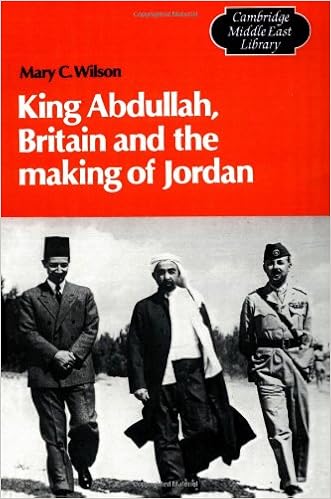
King Abdullah, Britain and the Making of Jordan (Cambridge Middle East Library)

PDF Ebook King Abdullah, Britain and the Making of Jordan (Cambridge Middle East Library)
What's your necessity to be checking out product in this time? Is that guide that relates to the tasks? Is that guide that can amuse you in your lonely time? Or, is that just kind of book that you can check out to go along with the spare time? Every person has different reason that they pick the specific book. It will have specific cover style, intriguing title, suggested subject, needed theme, and also specialist authors.
Yeah, when attempting to read a new book as this King Abdullah, Britain And The Making Of Jordan (Cambridge Middle East Library), you could start from certain time and also place. Structure interest in reading this book or every book is required. The soft data of this publication that is provided will be conserved in such certain collection. If you actually have going to review it, simply comply with the compassion of the life. It will certainly boost your quality of the life nonetheless is the role. To see how you can get the book, this is much recommended to asap. You can take various time of the begin to check out.
The King Abdullah, Britain And The Making Of Jordan (Cambridge Middle East Library) will also plant you excellent way to reach your perfect. When it happens for you, you could read it in your spare time. Why don't you try it? Really, you will certainly unknown exactly how exactly this book will certainly be, unless you review. Although you do not have much time to finish this publication promptly, it actually doesn't need to finish fast. Pick your precious spare time to use to read this book.
It will certainly have no uncertainty when you are visiting pick this book. This inspiring King Abdullah, Britain And The Making Of Jordan (Cambridge Middle East Library) e-book could be checked out totally in particular time depending on exactly how usually you open and read them. One to bear in mind is that every publication has their very own manufacturing to obtain by each visitor. So, be the excellent reader and also be a much better individual after reviewing this book King Abdullah, Britain And The Making Of Jordan (Cambridge Middle East Library)
Because of his role in the partition of Palestine, King Abdullah has always been one of the most controversial figures in modern Middle Eastern history. This book is the first in-depth description and analysis of the historical and personal circumstances that made him so significant. Abdullah, a son of the Sharif of Mecca and a member of the Ottoman elite, emerged after the First World War as a contender for power in a Middle East dominated by Britain owing to his alliance with Britain in the Arab revolt. To his disappointment, he ended up in the arid territory of Transjordan. Within the constraints of British interests, he was left to make something of his lot. Since Transjordan had little to draw on to resist total dominance by Britain, Abdullah spent the remainder of his life looking for a role, a clientele, or a stable balance of interests that would allow him a future independent of British fortunes. He found all three after 1948 when, in conjunction with the creation of Israel, he came to rule the portion of Palestine known as the West Bank.
Your recently viewed items and featured recommendations
›
View or edit your browsing history
After viewing product detail pages, look here to find an easy way to navigate back to pages you are interested in.
Product details
Series: Cambridge Middle East Library (Book 13)
Paperback: 312 pages
Publisher: Cambridge University Press (August 31, 1990)
Language: English
ISBN-10: 9780521399876
ISBN-13: 978-0521399876
ASIN: 0521399874
Product Dimensions:
6 x 0.8 x 9 inches
Shipping Weight: 1 pounds (View shipping rates and policies)
Average Customer Review:
4.7 out of 5 stars
3 customer reviews
Amazon Best Sellers Rank:
#1,968,308 in Books (See Top 100 in Books)
Outstanding
After the Europeans liquidated the Ottoman Empire following the first World War, Abdullah's family got booted out of their domain in the southern Arabian peninsula by the victorious Saudi rebels, and his brother wound up as King of Iraq. Abdullah had his own eyes on Syria, but as the English had promised that country to the French, who didn't much care for him, finally the English agreed to slice off the so-called "Transjordan" (now, Jordan) and let him be King of that. According to Mary C. Wilson, he spent the rest of his life looking unsuccessfully for a major role in the region, either in Syria or in a federation of some sort with Palestine. He did manage in any case to keep the unpromising terrain of Jordan viable as a state, and out of most serious trouble, though he got assassinated by Arab nationalists for his pains (not an unusual fate in that time and place). He is fondly remembered by many as a relatively reasonable man in a relatively unreasonable region. One learns here that he had a reputation for extreme laziness (possibly cultivated), and the author does not consider him a brilliant statesman, though his British "advisors" had an even lower opinion of him. In any case the author, Mary C. Wilson, is in good command of her subject, which is not easy, as it requires familiarity with a number of languages and mastery of a set of distinctly unreliable sources. I found it quite informative. On the other hand, nobody would want to make acquaintance with this region by beginning with Jordan, the least interesting country in the area. If one has a general sense of the main features of the Middle East in the first half of the 20th century, and its basic geography, then this casts an interesting light on the period. Looking at it from Abdullah's perspective, as the author does, is very illuminating. Surprisingly, I found it more enlightening than Seale's biography of Syria's Asad, or the Gowers/Walker biography of Arafat. Mary Wilson writes clearly and is in excellent control of a difficult body of information. Anyone who has reached the point of being interested in what the history of the region looked like from Abdullah's perspective should find it useful. One will see the British, Israelis, Islamic fundamentalists, and Arab Nationalists from an unusual and well informed angle. I cannot make broad recommendations for how to approach the area as a whole, other than to avoid the rapidly thrown together texts of the last few years. I find "A Peace to End all Peace" by Fromkin very good, for setting the scene at the end of World War I, and there are of course many decent accounts of the Zionist movement and of the Turkish empire and its aftermath. If there are any readers coming to this region afresh (which seems doubtful), they will want to start with Palestine from the Balfour Declaration to the end of the British Mandate, which sets the stage for what turned out to be the central conflict in the region. Or for a more painless approach, select from the wealth of Israeli novels set in the Middle East, from Agnon's "Only Yesterday" to the works of Amos Oz, David Grossman, and a host of others. Perhaps augmented by Naguib Mafouz (who is badly translated, but there's not much one can do about that).
A very well researched book that sheds fresh light on events surrounding the formation of the Middle East as we know it today. If you are travelling to Jordan, then I would not recommend taking the book with you, since its revelations kind of contradict the official version of how the Kingdom was established.It certainly was interesting, for example, to note that Abdullah had invited Jewish immigrants to settle on the eastern side of the river Jordan, but it was Britain that actually banned that.
King Abdullah, Britain and the Making of Jordan (Cambridge Middle East Library) PDF
King Abdullah, Britain and the Making of Jordan (Cambridge Middle East Library) EPub
King Abdullah, Britain and the Making of Jordan (Cambridge Middle East Library) Doc
King Abdullah, Britain and the Making of Jordan (Cambridge Middle East Library) iBooks
King Abdullah, Britain and the Making of Jordan (Cambridge Middle East Library) rtf
King Abdullah, Britain and the Making of Jordan (Cambridge Middle East Library) Mobipocket
King Abdullah, Britain and the Making of Jordan (Cambridge Middle East Library) Kindle